Early 1940s Two-Piece Suit Dress Sewing Pattern | Past Patterns 9013
$20.00
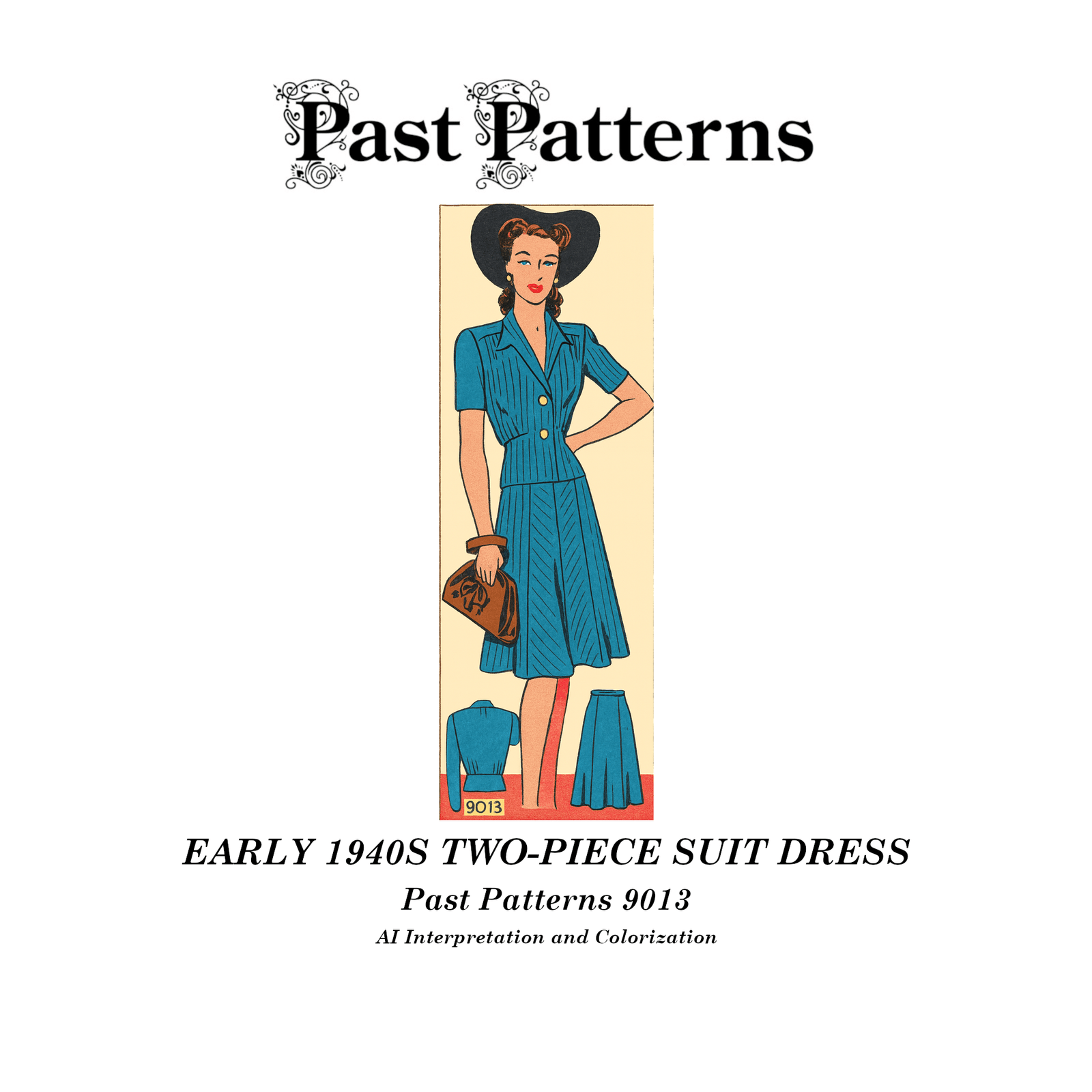
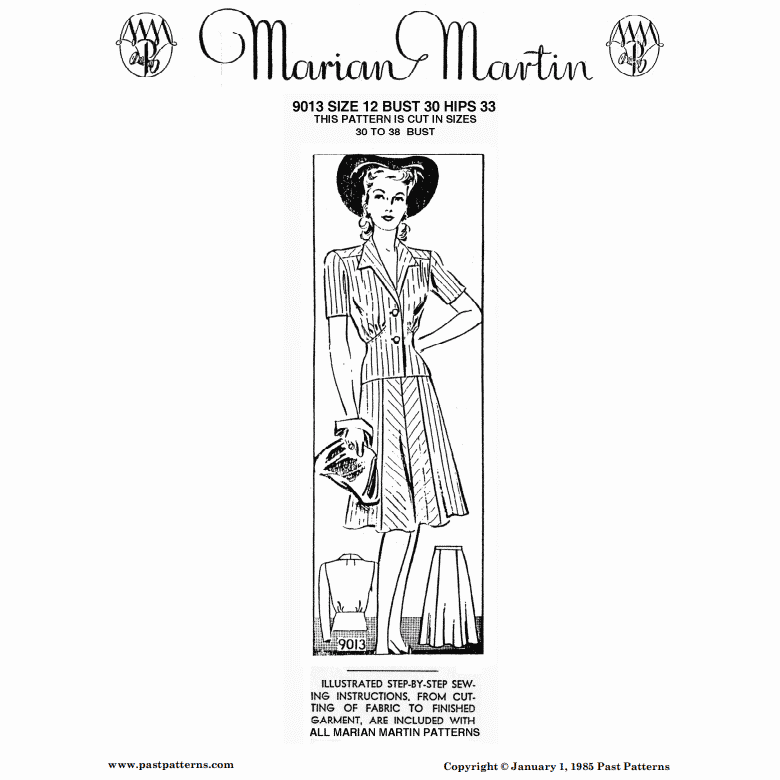
Early 1940s Two-Piece Suit Dress Sewing Pattern featuring a fitted blouse, paneled skirt, and optional sleeve variations in Bust 30″.
Skill Level: 3/5
Intermediate level due to fitted blouse shaping, collar construction, sleeve setting, buttonholes, and panel skirt assembly.
999 in stock
Get Free Shipping
On all US Orders over $50!
Early 1940s Two-Piece Suit Dress Sewing Pattern | Past Patterns 9013
$20.00
Early 1940s Two-Piece Suit Dress Sewing Pattern featuring a fitted blouse, paneled skirt, and optional sleeve variations in Bust 30″.
Skill Level: 3/5
Intermediate level due to fitted blouse shaping, collar construction, sleeve setting, buttonholes, and panel skirt assembly.
999 in stock
Get Free Shipping
On all US Orders over $50!
All of our patterns tell a story.
Why Choose This Pattern?

Early 1940s Two-Piece Suit Dress Sewing Pattern
This Early 1940s Two-Piece Suit Dress Sewing Pattern was originally published by The Marian Martin Pattern Company. Past Patterns 9013 recreates a refined wartime-era ensemble that combines the tailored appearance of a suit with the practicality and efficiency of a dress. This design reflects the growing demand in the early 1940s for garments that were both stylish and economical, offering a polished, structured silhouette suitable for daywear, work, and social occasions.
The Early 1940s Two-Piece Suit Dress Sewing Pattern features a fitted blouse with carefully shaped front slashes that contour the waist, paired with a paneled skirt designed to create a slim, elongated hipline. The extended shoulder line—so characteristic of early 1940s fashion—enhances the structured look while visually balancing the figure. The result is a garment that delivers the crisp, well-groomed appearance of a suit while maintaining the simplicity and versatility of a coordinated dress.
As described in period sources from 1942, the “suit-dress” became an essential wardrobe solution during wartime, offering both elegance and practicality. This pattern captures that transition perfectly, blending tailored styling with efficient construction techniques suited for home sewing.
Design Features of the Early 1940s Two-Piece Suit Dress Sewing Pattern
- Fitted blouse with front shaping slashes for a trim waistline
- Paneled skirt designed to create a slender, flattering silhouette
- The extended shoulder seam is typical of early 1940s fashion
- Optional sleeve variations: short sleeve or long/three-quarter sleeve
- Coordinated blouse and skirt for a true “suit-dress” effect
- Optional contrast collar for added period styling flexibility
Pattern Details
- Past Patterns 9013
- Early 1940s Two-Piece Suit Dress Sewing Pattern
- Originally published by Marian Martin
- Includes 11 pattern pieces
- Designed for Bust 30", Waist 26", Hips 33" (Size 12)
- Original sizing range noted in instructions: Misses 12–20
- 1/2" seam allowances used throughout
What Is Included with This Printed Pattern
This printed pattern package includes full-size pattern pieces printed on 36" wide paper, along with the original-style instruction booklet and reproduced envelope artwork. The instructions provide illustrated, step-by-step guidance covering the complete construction process—from cutting layouts to final garment finishing.
The instruction booklet includes detailed sewing steps for blouse assembly, collar construction, sleeve variations, skirt panel assembly, placket finishing, and belt construction. Fabric layout diagrams and cutting guides are also included to help ensure efficient use of materials.
As with all Past Patterns sets, we also include our guide to garment editing, allowing experienced sewists to adjust fit as needed.
Fabric and Yardage Requirements
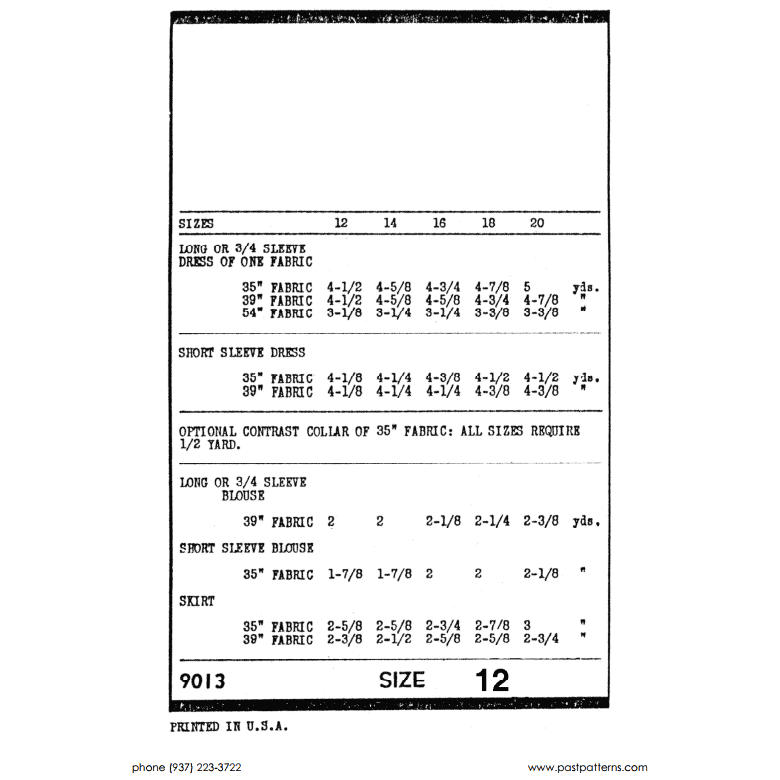
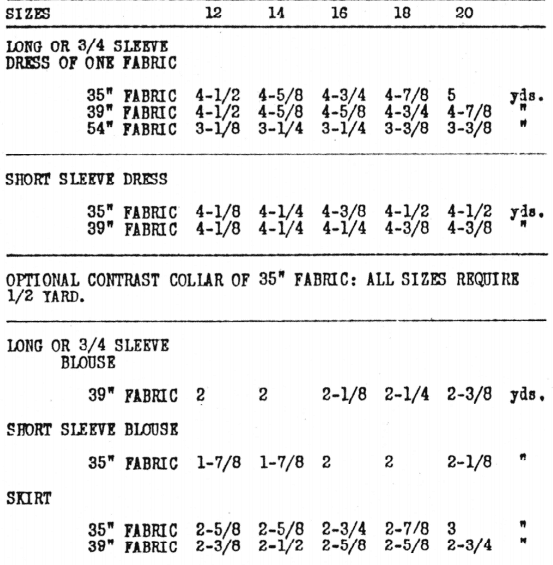
The original yardage requirement for this Early 1940s Two-Piece Suit Dress Sewing Pattern is approximately 4-1/8 yards of 36" wide fabric. The instruction booklet also provides alternate yardage estimates for different fabric widths and sleeve variations, offering flexibility depending on your chosen version.
Period-appropriate fabrics for this style include rayon crepe, alpaca-type crepe, French crepe, novelty wool, and similar dress-weight materials. Popular early 1940s colors included navy, forest green, luggage brown, sunset red, and muted blues, all of which complement the tailored lines of this design.
Construction Overview
This Early 1940s Two-Piece Suit Dress Sewing Pattern reflects classic wartime construction methods. The blouse includes dart shaping and gathered sections formed through slash construction, while the collar is applied using traditional facing techniques. The sleeves are set with easing to achieve the proper period shape, and the skirt panels are carefully joined to maintain the smooth, slim silhouette.
The pattern also includes period details such as bound buttonholes, placket finishing, and a structured belt, all contributing to the garment’s tailored appearance. These techniques are clearly outlined in the illustrated instruction booklet.
Skill Level: 3/5
This Early 1940s Two-Piece Suit Dress Sewing Pattern is best suited to an intermediate sewist. While the construction is logical and well-documented, it includes several techniques that require accuracy and attention to detail, such as blouse shaping, collar attachment, sleeve setting, buttonhole finishing, and panel skirt assembly.
The difficulty rating is based on the number of pattern pieces, the presence of fitted shaping, and the inclusion of multiple garment components (blouse and skirt). The illustrated instructions make the process approachable for those with prior garment sewing experience.
Historical Context
The Early 1940s Two-Piece Suit Dress Sewing Pattern reflects a key shift in women’s fashion during World War II. As fabric conservation and practicality became more important, garments like the suit-dress offered a way to maintain a polished, professional appearance while minimizing excess material and complexity.
This design exemplifies the balance between elegance and efficiency that defined early 1940s clothing. The structured shoulders, fitted waist, and clean skirt lines all contribute to the confident, streamlined silhouette associated with the era.
Printed Pattern Format
This is the printed version of the Early 1940s Two-Piece Suit Dress Sewing Pattern. Pattern pieces are printed full size on 36" wide paper and are ready for immediate use.
Looking for the digital version? View the download listing here: Early 1940s Two-Piece Suit Dress Downloads.
Copyright Past Patterns 1979–2026. All rights reserved.
Additional information
| Weight | 7 oz |
|---|---|
| Dimensions | 13 × 10 × 2 in |
Sizing Information
(Metric size sheet opens as a PDF in a new browser tab)
Preferred Vendors
Past Patterns works with vendors from all over the world to help us replicate the amazing articles of clothing. Now you can too!
Visit our preferred vendors page to order directly from some of our top recommended suppliers.
Related products
-
Early 1940s Day Dress Sewing Pattern | Past Patterns 4142
$22.00 -
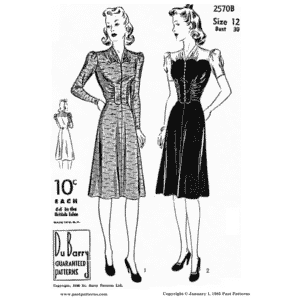
Early 1940s Junior Miss Dress with Three-Piece Yoke Sewing Pattern | Past Patterns 2570B
$22.00 -
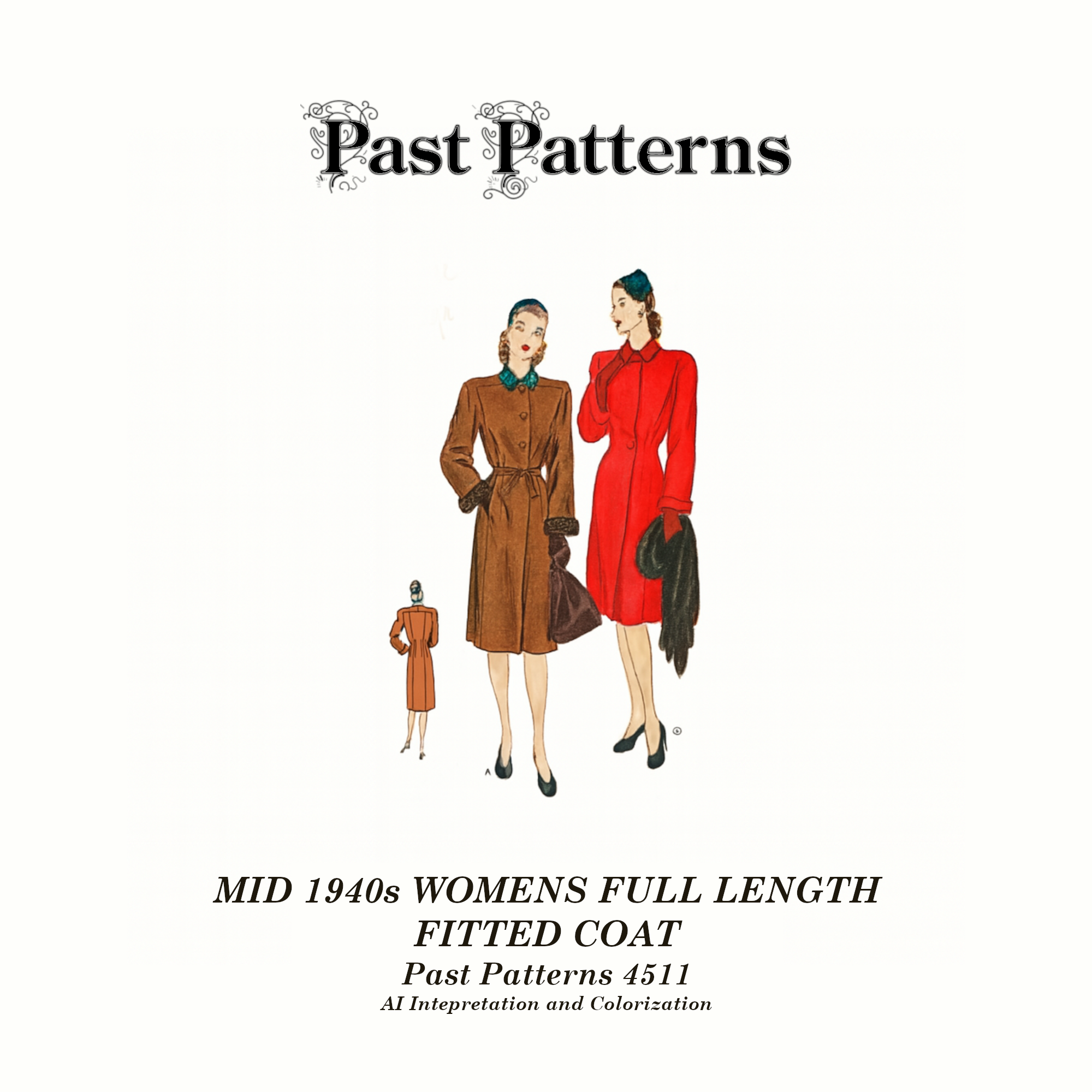
Mid-1940s Womens Full Length Fitted Coat Sewing Pattern | Past Patterns 4511
$23.00 -
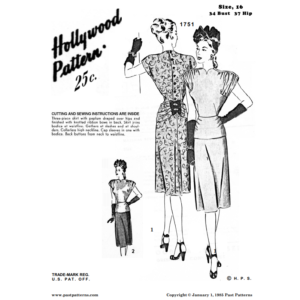
Late 1940s Dress with Gathered Cap Sleeves Sewing Pattern | Past Patterns 1751
$22.00
FAQ's
(Frequently asked questions)
Why are both Trowsers and Trousers listed on site?
Over the last 200 years, much like the human body, our style of language has changed. For vintage patterns, we attempt to use the language of the day where possible.
Can you grade (edit) a Vintage Revival pattern for my size?
please contact us with the specific pattern number and the specifications you require. We have staff available for this for an additional fee.
What sizes do Past Patterns patterns come in?
Our patterns, with some exceptions, are manufactured in sizes 8 through 26 for women and sizes 34 through 54 for men. Most patterns are multi-sized. For a complete listing of measurements in inches see the size chart.
Do you have vintage patterns (manufactured prior to 1950) that you want to sell?
we are always on the lookout for original, American designed, vintage patterns especially for categories outside of current items. We are interested if you have 1 pattern or 1000 patterns. Give us a call to discuss.
Why is my pattern size different from my off the rack dress size?
We use the U. S. Board of Standard Measurements to size our patterns. The ready made clothing manufacturers have their own set of sizes developed from their own statistics. For a complete listing of measurements in inches see the size chart.
How are the patterns packaged?
We package our patterns in two forms: Bond Paper and Tissue. Except for the Tissue patterns, each is slipped into a reusable plastic sleeve. Many contain documentation in the form of Historical Notes or the printer ie., Butterick. Because the patterns are printed in house to order, they can take from three to seven days. Tissue patterns, which are printed out of house, are available to ship immediately.
What does a Corset Kit contain in addition to the Corset pattern?
In addition to the pattern, the kits contain everything you need to make the corset except the thread. The kits contain, according to their type, fabric and lining, stays, clasp or busk board, back lacing, tape for finishing the edges, trim lace, ribbon, leather, tin stock, waist tape, punch and setter, eyelets, marking pencils, cording, reed and a loop turner.
Need a pattern in your language?
we can translate our instructions into just about any language
Have an old and incomplete Past Patterns item. What can I do?
The answer depends on if the pattern is still in production or not. If it is, please mail us the old pattern and we will ship you a copy of the latest pattern for a minimal fee along with normal shipping charges. If the item is no longer in production, we would need to know exactly what you have to determine the best course of action to help you.
What is the difference between a Past Patterns original pattern and a Vintage Revival pattern?
The Past Patterns originals were designed in house and based upon the research, disassembly and time of Saundra Ros Altman. These designs come from finds all over the United States reaching from San Diego, California to the Smithsonian Museum in Washington, DC. She created the initial patterns, the sizing charts and the instruction content. Many of the these patterns are multi-sized or are available in various sizes. For the most part, these designs are done taking into account the modern human body's shape, height and weight. The Vintage Revival patterns are traces or copies of an old, mass produced pattern; the first mass produced patterns came out in the 1850s. For the most part, you get exactly what came in the original package; in some cases, Saundra has appended historical notes to the instructions. The Vintage Revivals patterns, being copies of the originals, generally only come in one size and are based upon the size and shape of the human body from the era the pattern came from.
What software do you use to create patterns?
We utilize PW Studio for our designs. Isabelle Lott, a contributor over the years to Past Patterns, is the owner of the company and will be happy to answer an software related questions you have. Her software is available for licensing.
What measurements do I need to know to order a Corset Kit?
The bust and back length. The back length is measured from the prominent bone at the base of the neck to the natural waistline.
Where can I see the appropriate clothing fabrics for the 18th and 19th centuries?
You can see 1740 through 1940 fabrics in a book titled "Textile Designs" by Susan Meller and Joost Elffers. The subtitle states, "Two Hundred Years of European and American Patterns for Printed Fabric by Motif, Style, Color, Layout and Period and 1,823 Illustration in Color." What they don't say is that 90% of the swatches pictured are life size. The ISBN is 0-8109-3853-7. A second book is Wearable Prints, 1740-1860, History, Materials, and Mechanics by Susan W. Greene. The ISBN is 978-1-60635-124-6. Great books! Order it from your local library that has interlibrary loan capability if you cannot afford the price. There are now many sources for appropriate fabric through the Internet.
Where can I find antique patterns to purchase?
On the Internet try: "Patterns from the Past."
Need a pattern tomorrow?
we do offer expedited domestic shipping for extra fees. We can also expeditie international shipments but delivery dates overseas cannot be promised.
Becoming a Wholesalers of our patterns
We offer Wholesalers significant discounts that will allow both your and our businesses to flourish.
Why don't we sell PDFs of our patterns - First due to piracy. We have spent over 40 years creating and tracing these patterns along with researching them. We print and ship all of our patterns ourselves. If we started sending out PDFs, in no time, copies of our Intellectual Property would be all over the internet and we would be out of business. Second, some of our patterns are constantly being updated. We want our clients to get the BEST POSSIBLE version of our products.